This morning I have been reading a recently published paper by the UN FAO titled: ‘Guidelines to increase the resilience of agricultural supply chains‘. This incredibly interesting publication details the need for the global food system to be increasingly able to recover from shocks and stresses. It contains a myriad of information about how interconnected our agricultural supply chains are and how when creating policies to increase resilience all stages of the chain needs to be accounted for.
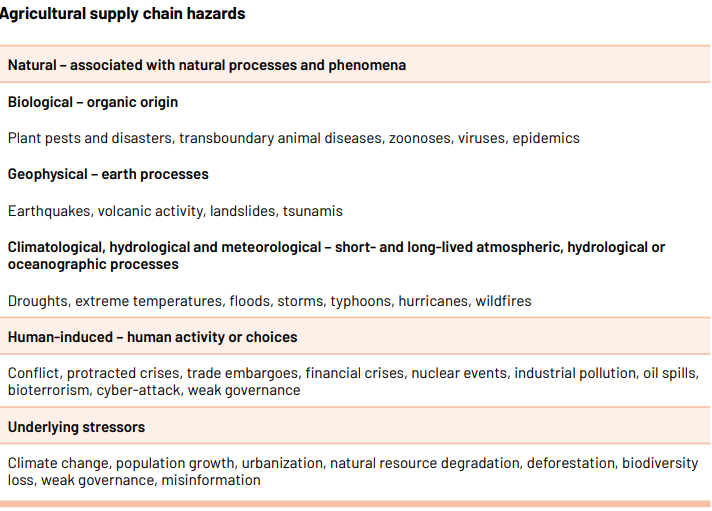
As my project is analysing the Resilience of Viet Nam’s food system to biophysical and economic shocks this paper will hopefully prove to be useful. This overview table was in the paper and provides a concise explanation of the potential hazards the agricultural and food systems can face. This was adapted from research by both the Integrated Research on Disaster Risk (2014) and the Centre for Research on the Epidemiology of Disasters (2023). This paper shows that the frequency of these hazards has increased since the 1960s!
Vietnamese food systems have changed significantly over the last fifty years, and I can see this, especially in my data over the last ten. After the reunification of North and South Vietnam in 1975, there was a need to promote sourcing food for an increasing and wealthier population, also driven by the substitution from collectives to commercial farming (Nguyen-Minh et al., 2023). This paper examined the change in production levels of pork and vegetables in Viet Nam and what drove them in an attempt to characterise the food production transitions. For example, the pork industry in the country was hard hit by African Swine Fever in 2019, which had a destabilising effect on production levels.
Another potential destabilising product coming out of the country in Bananas. Viet Nam is a globally important banana-producing country, and a certain pathogen poses a VERY real risk to the banana supply chains in the country. As I said last blog, my research indicates so far that Viet Nam is almost self-sufficient, importing less than 2% of their bananas (FAOSTAT, 2023). However, in the future, the fungal disease TR4 Fusarium wilt may affect the crop both locally and globally. In Viet Nam, the banana production area might reduce by up to 71% within the next 25 years, requiring either a shift in eating practices, growing practices, or a radical change in the Vietnamese banana crop (Le Thi et al, 2022).

As part of some self-directed learning, I also completed the ‘Knowledge Management for Emergency and resilience programming course’ from the FAO. I thought this might be useful in order to gain more insight into how resilience and knowledge management might be applied in a genuine scenario. While it is designed for managers, monitoring and evaluation officers, and professionals new to this field, rather than an academic researcher, I think learning a new perspective and increasing my knowledge can do no harm.
Try it yourself: FAO Knowledge Management for emergency resilience programming course
FAO. 2023. Guidelines to increase the resilience of agricultural supply chains. Rome. https://doi.org/10.4060/cc5481en

Le Thi, L., Mertens, A., Vu, D., Vu, T., Anh Minh, P., Duc, H., . . . Janssens, S. (2022). Diversity of Fusarium associated banana wilt in northern Viet Nam. MycoKeys (Sofia, Bulgaria), 87, 53-76.

GUYEN-MINH, Q., PRINS, H., OOSTERVEER, P., BROUWER, I. D. & VIGNOLA, R. 2023. Food system transitions in Vietnam: The case of pork and vegetable networks. Environmental Innovation and Societal Transitions, 47, 100716.